Translate

Saturday, August 27, 2022

Mexico. San Pablo de Las Salinas

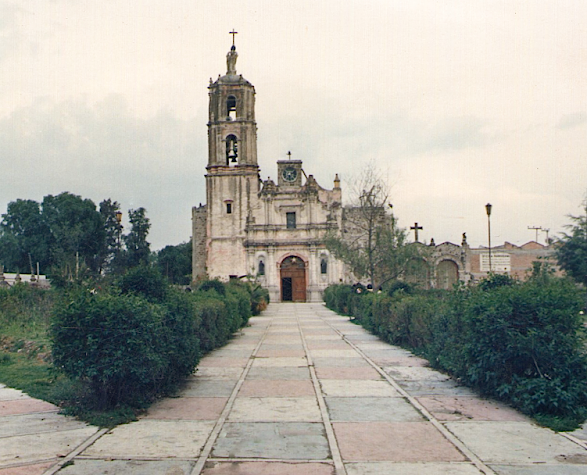
 This dismal outlying barrio, just north east of Tultitlan, in northern Mexico City nevertheless boasts a pretty church dedicated to Saints Peter and Paul. It is also home to a number of notable carved stone crosses.
The Church

The single nave church with added south aisle dates from the mid 1600s. It is fitted with a modest retablo style facade that houses statues of the patrons Sts Peter and Paul.

The Main Altarpiece

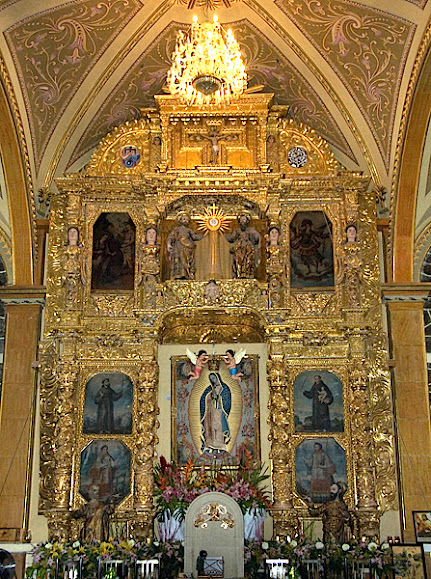
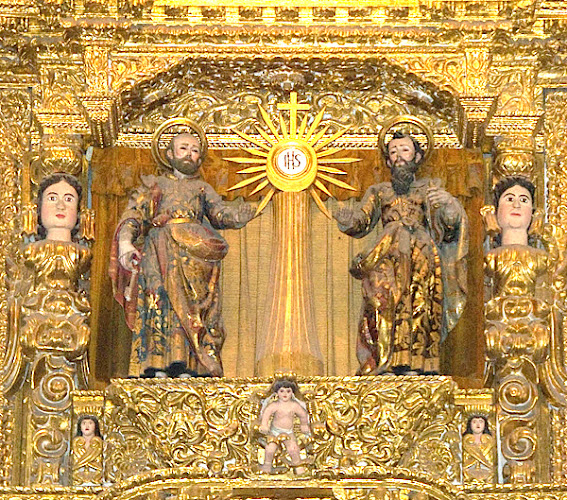
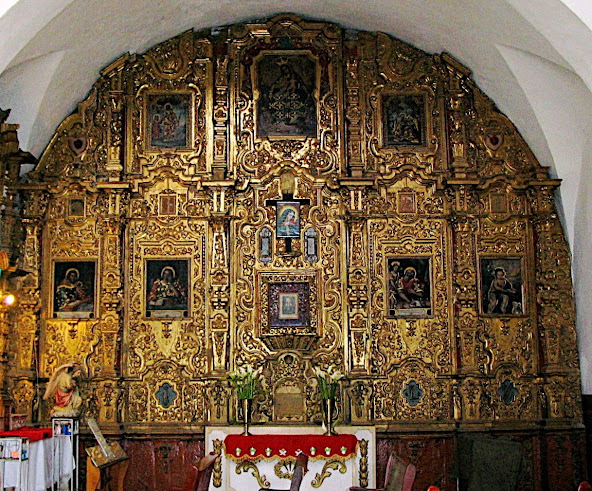
Fashioned in ornate baroque style with gilded spiral columns and estípites headed by angels' heads, the retablo showcases paintings of Franciscan saints and martyrs together with, again, statues of Peter and Paul, here flanking a monstrance in the upper section.

The Atrium Cross

Of uncertain date, this large cross is crowded on all four sides with symbols of the Passion carved in soft relief. The dejected, puffy Face of Christ at the axis trails long locks of hair but wears no visible Crown.
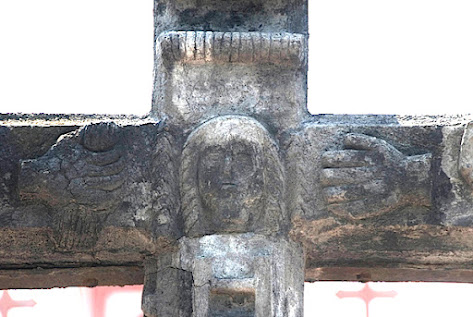
Following the pattern of many others in the area, profile heads and hands on the arms point inwards to the Face. Wounds with pierced holes and droplets of blood are squeezed in beside the finials on either side; a third Wound is inserted below the Lad- der on the main shaft.

Other objects include the Rooster atop a conical Column emblazoned with Lance, Reed and a superimposed Host. A ridge of stacked Coins transects the neck below the INRI placard, and a goggle eyed Skull and Bones jut from the pedestal at the foot of the cross.

On the reverse side, a Crown at the axis stands in a column of religious monograms. Unusual reliefs include that of the Virgin, reminiscent of the Dolorosa at Acolman, above a ghost like flying angel. Bold fleur-de-lis finials with lozenge like leaves cap the arms and head.

A former porteria fronts the convento. A sculpted cross, also carved with Passion symbols, stands atop its triple arcade.

porteria cross

A fine triple west gateway, also capped with carved crosses, commands access to the large atrium.

text © 2022 Richard D. Perry
images courtesy of Niccolo Brooker and ELTB 

Sunday, August 21, 2022

Mexico. Santiago Ayapango

Resting on the southern slopes of the volcano Popocatepetl, the former convento of Santiago Ayapango was founded by the eminent Franciscan Fr. Martín de Valencia in the mid 1500s as a visita of Tlalmanalco.
The present cruciform church rests atop the foundations of the 16th century mission here, and the front is fashioned in baroque style with construction dates from the mid 1600s to the early 1700s.
Half columns with wavy fluting frame the doorway whose arch is adorned with scrolled vegetal reliefs.
   Similar reliefs in grotesque style patterns accent the features of the upper facade—the paired columns beside the choir window, a round opening in the gable and the pilasters to either side of the sculpture niche above the doorway, which contains an archaic stone statue of the patron Santiago Matamoros which may date from the early years of the mission.
Similar reliefs also adorn the spiral Corinthian columns framing the openings of the bell tower, which is oddly emblazoned with a folkloric relief of St Barbara?:

Inside the church, the main altarpiece is executed in late baroque fashion with estípite pilasters, paintings and statuary that include St Francis, Our Lady of Sorrows and the image of St James as a pilgrim (Santiago Apostol).
Other colonial art treasures of note inside the church include a small but gem like retablo of Guadalupe framed by gilded spiral columns; and a densely composed early18th century painting of the Redemption or Animas/Last Judgment signed by the artist Diego de Rojas.
A dashing equestrian figure of Santiago Matamoros rests in the nave, to be taken out in Procession on his feast day in July.
The former convento, with its well kept cloister, adjoins the south side of the church.

text © 2022 Richard D. Perry
images courtesy of Niccolo Brooker and ELTB 

Wednesday, August 3, 2022

Cristóbal, Antonio and Juan. Los Niños Martires in Mexican colonial art.

Among those canonized by Pope Francis in October 2017, were a trio of Mexican saints known as Los Niños Martires.
   One of the best known episodes of the Spiritual Conquest of Mexico is that of the Niños Martires.
   The story goes that shortly after the conquest, in 1527, Axotécatl, one of the Four Lords of Tlaxcala—allies of Cortés in the defeat of the Aztecs—sent his three sons to be educated in the Franciscan monastery of Tlaxcala.
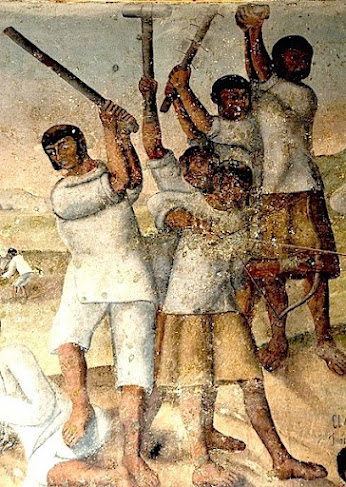
   On their return, the young men set about smashing idols and reproaching their father for his polygamy and excessive drinking. The enraged lord beat his son Cristóbal and had him burned him to death. The other two boys, Antonio and Juan, fled but continued their preaching and iconoclastic ways, until they too soon suffered a martyr's fate. 
Although popular figures of the trio appear in a few Mexican churches, the martyrdom of the three only appears in two colonial era murals; initially in the porteria of the Franciscan monastery of Ozumba east of Mexico City and later in the church of Santa Maria Atlihuetzia, in the state of Tlaxcala, the location of some of the events portrayed.
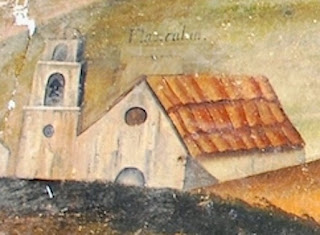
At Ozumba, the boy martyrs are identified by inscriptions and are shown in a rural landscape being killed by the villagers by different methods in graphic detail. Churches in the background portray the nearby towns of Tlaxcala (l) and 
Tecali (r). Note the broken idol on the lower right.
Ozumba mural detail

Ozumba mural details


The parish church of Santa Maria Atlihuetzia is a shrine to the memory of Los Ninos Martires, as the boys are known in the pantheon of the Mexican church; their fate is recorded in a pair of dramatic, late colonial paintings with Nahuatl speech inscriptions.
text and images ©2002 Richard D. Perry

Wednesday, July 20, 2022

Oaxaca. Ozolotepec


We journey south beyond the city of Oaxaca to the remote Zapotec village of Ozolotepec in the rugged Sierra Sur of Oaxaca.
At the heart of the community stands the 17th century church of Santa Maria Ozolotepec. 
The broad, much rebuilt church front presents a modified retablo facade flanked by stubby single tier bell towers. Statues of Sts Peter and Paul occupy niches on either side of the arched west doorway.
Ozolotepec. The nave after the 2017 earthquake.

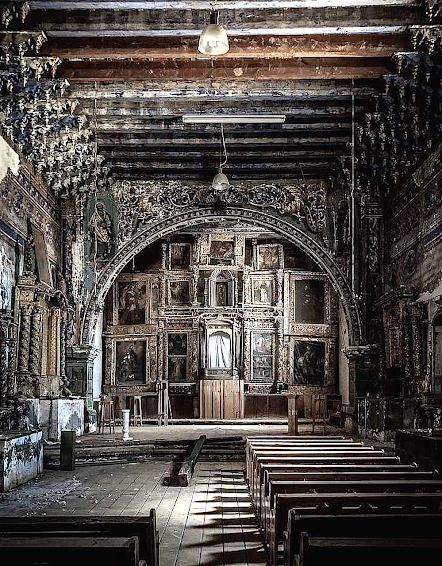
Inside, the expansive single nave is covered by a spectacular, painted, beamed ceiling hung with spindles. Several baroque altarpieces line the nave, most notably the main retablo and the side altarpiece of St Antony.
   
The retablo mayor
The Main Retablo
 Bankrolled, like the church as a whole, by the eminent cleric Pedro de Otálora Carbajal, who also funded the building of the famous Sanctuary of La Soledad in the city of Oaxaca, the main altarpiece showcases a number of paintings. These include portraits of  St Dominic, St Lawrence and St Gregory as well as Catherine of Alexandria and the Archangel Michael.
St Dominic;                                                  St Lawrence
St Gregory;                                               Nicholas of Tolentino

The side retablo of San Antonio is of perhaps greater historical interest. 
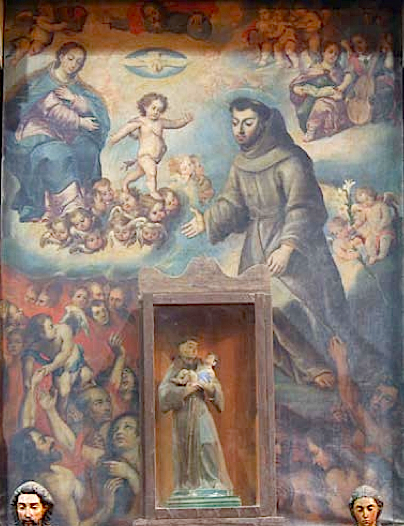
In the center panel, cast in the form of a scene of Purgatory, the commanding figure of St Anthony stands above the struggling souls (animas) , among whom is, on the left, a bearded figure being rescued by an angel, thought to represent the church patron Otálora, and on the right an indigenous man assumed to be a prominent native figure and possible donor of the altarpiece, touching the cord of the saint's robe.

text © 2022 Richard D. Perry
photography by Fernando Herrera
text source: UN PÁRROCO EMPRENDEDOR Y LITURGISTA: EL RETABLO DE SANTA MARÍA OZOLOTEPEC   Selene del Carmen García Jiménez  (2001)
Aficionados may be interested in a beautiful modern house currently for rent in a select suburb of Oaxaca City. For longer term rental only.   Contact the owner at: cwinteroax@gmail.com

Monday, July 11, 2022

Oaxaca. La Defensa

For the last in our current series on the lesser known churches of the city of Oaxaca, we visit La Defensa.
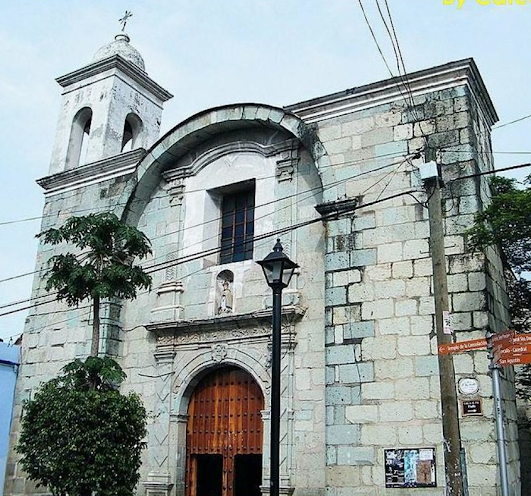
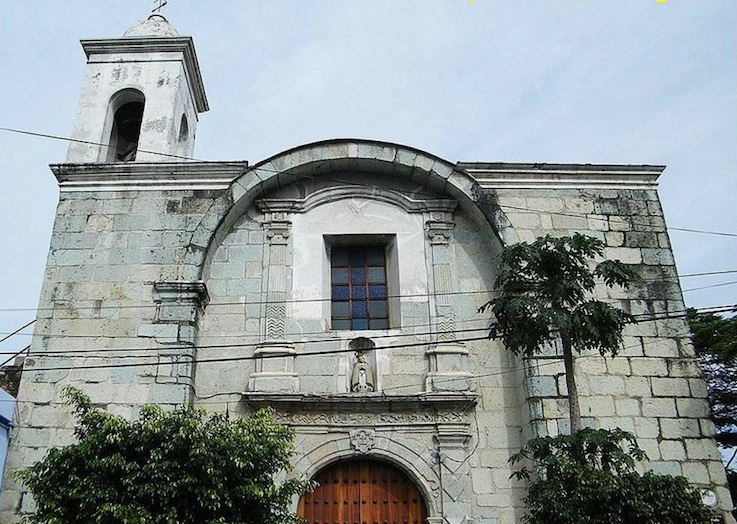
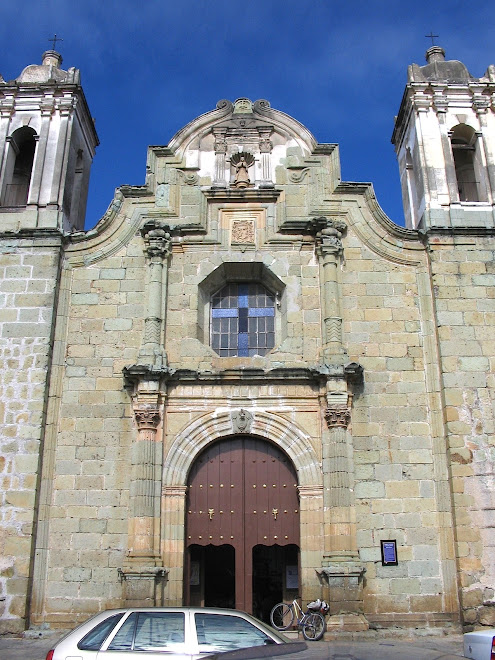
   The simple baroque exterior of this little chapel, located close to San Francisco and dedicated to the rarely honored Virgin of La Defensa, is another minor Oaxacan classic.
Rebuilt between 1786 and 1792 after an earthquake in 1795, the cruciform church features sober portals, rebuilt more than once following further quakes—west and north facing—with attractive baroque accents. 
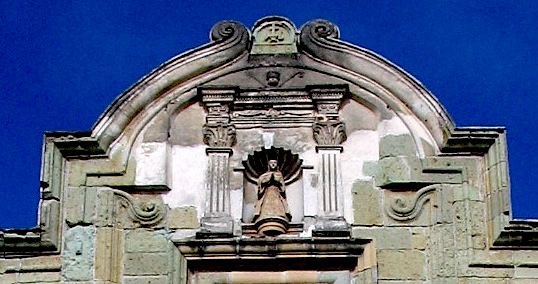
The west facade, faced with local greenstone, is neatly framed by an recessed arch linking the flanking tower bases. A diminutive painted statue of the Virgin occupies a niche above the doorway. 
Pillowed pilasters and layered cornices frame the more elaborate north doorway, which is capped by a fanciful curving pediment adorned with urns and volutes. The statue of a Spanish hidalgo bearing the insignia of the Order of Calatrava—probably a benefactor of the church—sits in the overhead niche.
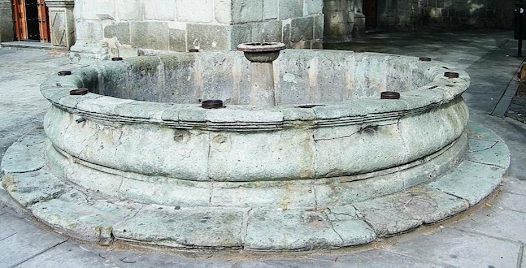
As at Las Nieves, a circular fountain, part of the old city water system, stands in front of the church.
La Defensa is also worth a visit for its Churrigueresque main retablo. As glimpsed from the west entry, the altarpiece radiates a golden glow at the dim far end of the chapel. Two tiers of elongated estípites bracket several dark 18th century paintings portraying the Life of the Virgin, each enclosed by a complex mixtilinear frame. Swirling, shell-like forms fill the intervening spaces and cover the finely worked, gilded altar table in front. In the central niche rests the image of the Virgin known as The Sweet Name of Maria.
A second gilded altarpiece in similar style, dedicated to the Virgin of Guadalupe, stands in a painted niche along the nave.
Also of note is another colonial art work, that of St Joseph with the Christ Child
text 2005/2022 Richard D. Perry
pictures by the author and from online sources
Aficionados may be interested in a beautiful modern house currently for rent in a select suburb of Oaxaca City. For longer term rental only.

Contact the owner at: cwinteroax@gmail.com

Sunday, July 3, 2022

Oaxaca. Las Nieves

In another of our posts on lesser known churches in the city of Oaxaca, we turn to the exquisite chapel of Las Nieves.
   Originally the chapel attached to the Jesuit seminary of San Juan, this gem of a church is now dedicated to Our Lady of the Snows, the popular patron saint of Rome. Founded in the late 16th century, the church suffered repeated earthquake damage, but was rebuilt in the early 1700s and again in the 1770s, after the Jesuits were expelled from Mexico.
Facing east, its typically Oaxacan greenstone facade is surprisingly sophisticated. Fluted Corinthian columns on high pedestals flank the elegant arched doorway, morphing into plain tritostyle columns on either side of the large octagonal choir window overhead.
A striking stepped gable crowns the facade, accented by discreet volutes and outlined by a multi-layered cornice.
   A monogram of the Virgin with crossed keys is carved in the keystone of the doorway, a reference to the statue of the Virgin of the Nativity housed in the upper shell niche. The monogram of Christ is emblazoned above the choir window. A nice touch is the fluted molding outlining the entire facade.

The Altarpieces
Despite its modest scale, Las Nieves is distinguished by the high quality and variety of its altarpieces. Although the main retablo is designed in the later neoclassical style, the gilded retablos in the transepts and side chapels are refined baroque works, reflecting both the traditional Oaxacan and more cosmopolitan Churrigueresque styles. 
The graceful retablo of St. Anthony of Padua—possibly the former main retablo—is now installed in a side chapel. Its projecting center pavilion features intricate spiral columns of interwoven ornament and sharply projecting capitals hung with spindles. The altarpiece is a showcase for 18th century paintings of archangels and episodes from the life of this popular Franciscan saint.
Equally impressive is the almost semicircular altarpiece of the Virgin of Perpetual Help in the north transept, dated 1793. Elegant estípite pilasters project against a gilded tapestry of richly worked foliage and strapwork. The paintings glow with gilded accents, with especially luminous effect in the portraits of the Evangelists and the elaborately costumed Virgin at the top of the retablo.
The figure of Christ occupies the retablo opposite, surrounded by muscular paintings of Passion scenes. A simple but affecting statue of St. Anne with the young Virgin also stands in the south transept.

In colonial times, the venerable circular fountain outside the church was the focus of the eastern barrios of the city. Weary water carriers rested their jars in the saucer-like indentations around the rim as they exchanged local news and gossip.


text 2005/2022 Richard D. Perry
pictures by the author and from online sources

Aficionados may be interested in a beautiful modern house currently for rent in a select suburb of Oaxaca City. For longer term rental only.

Contact the owner at: cwinteroax@gmail.com