In previous posts we looked at colonial statuary from the state of Chiapas. In this post we review a selection of the statues we featured in our other guidebooks*
Translate
Thursday, February 22, 2024
Mexico: colonial statues
Sunday, January 28, 2024
Chiapas. colonial statues
Last year we published images of two exceptional equestrian statues in the city of San Cristobal de Las Casas.
In this post we look at a few other fine statues from the colonial period in Chiapas.
First, the painted image in the Cathedral of its patron St. Christopher. Located beside the 18th century altarpiece in the south aisle, this noble statue of the youthful saint holding the infant Jesus is particularly expressive. The saint's curling hair and beard and his pale melancholy features in the Guatemalan manner contrast with his ornate coronet and flowing brocaded robe
This venerable statue of the celebrated martyr St. Sebastian is now placed in the church of Santo Domingo, in the coastal community of Chiapa de Corzo, formerly the provincial capital.
The saint gestures dramatically, the gushing arrow wounds on his limbs contrasting with his floral skirt, worked in a rich estofado embroidery.
Lastly we focus on a statue of the early Jesuit, St Francis Borgia, one of several portraying Jesuit notables contained in the spectacular early 18th century altarpiece at Teopisca, south of San Cristóbal, and formerly located in the Jesuit church of San Agustín, also in San Cristóbal.
Set on a pedestal in a shell like niche, as with the previous two statues, the saint is wrapped in a sumptuous robe embroidered in rich estofado style.
text and drawn images © 1994 & 2024 Richard D. Perry
all rights reserved
Saturday, January 6, 2024
Puebla. Los Reyes (2)
Epiphany! January 6th 2024.
On this feast day of the Three Kings we return to the Pueblan church of Los Reyes to look at the church interior, where ribbed vaults reflect the white and gold nave, refitted in neoclassical style.
Fortunately for us, some of the original baroque altarpieces remain.
The Main Retablo
This gilded two tier retablo in high Mexican baroque (estipite) style probably dates from the later 1700s. Prominent, swagged niche pilasters showcase statues of the Three Kings, and John the Baptist set between highly ornamental estipites.
The center tableau includes the Virgin (babeless) with Joseph and one of the Three Kings (Melchor).
Multiple cornices divide the retablo in layered style.
transept retablo 1.
A large triple tier gilded altarpiece of The Virgin of the Snows (Los Nieves) is fashioned in earlier baroque style with plain, rectangular pilasters on lower tier & Plateresque columns on second tier.
Colonial statues of mostly Franciscan? saints rest in shell niches across first tier; three more in niches on second tier, flanked by large paintings.
The Franciscan arms on third tier (gable) flanks a large center niche (empty) with window behind.
transept retablo 2
This smaller gilded retablo is framed in ornate Solomonic style with vine-encrusted spiral columns enclosing shell niches containing painted statuary of Evangelists. Dedicated to Our Lady of the Pillar it features large paintings illustrating scenes from the life of the Virgin Mary.
All the best for 2024!
© 2024 Richard D. Perry
images by the author and Niccolo Brooker by permission
Monday, January 1, 2024
Puebla. Los Reyes de Juarez
As is our custom at t his time of the year we like to feature a church dedicated to the Three Kings, or Los Reyes Magos
In this post , the first of two, we look at the town of Los Reyes, a medium size market town in central Puebla state, across the autopista from Acatzingo, SE of the city of Puebla.
This is the first of two posts on the church, focusing here on the ornate facade of painted stucco relief.
Facade:
The church of the Three Kings presents a triple tier facade in the lacy, wedding cake style of popular Pueblan baroque,; its classical retablo format is enhanced with abundant applied surface ornament of carved stucco in good condition, and usually painted orange or yellow.
Lower tier: classical fluted columns are set on complex, raised carved bases. doorway. Applied surface decoration - whorls, foliage starbursts, etc - appear on and between columns, and in spandrels over the plain arched doorway.
Oval medallions between the columns framing stucco reliefs of the Four Evangelists in folkloric style each with his symbol.
The plain rectangular choir window is flanked by ornamental relief pendants
Decorative pinnacles extend above pilasters into the gable area.
The large center relief medallion shows one of Magi kneeling before mother & child, flanked by two other kings (reyes) on horseback. A stucco star above at apex, is supported by angels.
The gable is capped by a sinuous projecting mixtilinear pediment.
Giant pilasters flank the entire facade, ornamented in the same fashion as the upper tier pilasters, as are the cornices between the tiers.A substantial, triple staged tower with prominent tiled dome on south side.
The ornamental atrium gateway follows the facade in style.
© 2024 Richard D. Perry
images by the author and © Niccolo Brooker by permission
Thursday, September 14, 2023
Yucatan. Santa Inez Dzitas
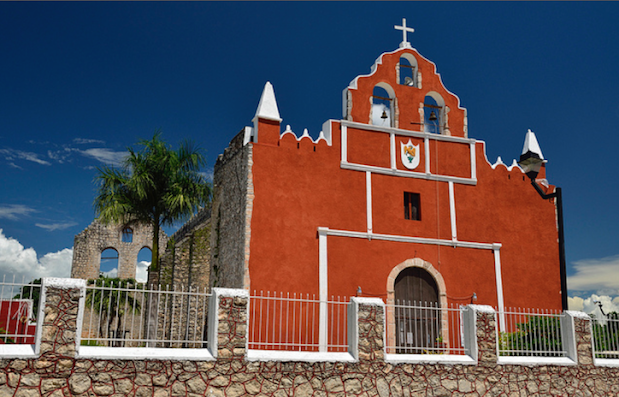
The old church of Santa Inez started life as a 16th century indian chapel It stands in a large, raised walled atrium, its broad stone apse housing the sacristy and friar’s room as well as supporting an impressive belfry which still stands.
The wide rectangular front is capped by a triple belfry and corner merlons. A modern sequence of alfiz like moldings frame the arched doorway, small choir window and a recently fashioned heraldic relief of an eagle holding a serpent.
Monday, August 28, 2023
Mexico City. San Lorenzo Xochimanca
San Lorenzo Xochimanca is best known for its well-preserved chapel of San Lorenzo Mártir, whose former atrium is now to a popular neighborhood park.
The Temple of San Lorenzo Mártir, originally a visita of Santo Domingo Mixcoac, dates from the 16th century.
The chapel was rebuilt in the 17th century by the Franciscans, and is constructed of brick and volcanic stone. The bell tower is noted for its colorful brickwork, from a local brickworks.
The facade retains the form of its original doorway, surmounted by a plain alfiz and ornamented with unusual rosettes with windblown centers.
A venerable stone cross stands before the church door, fashioned in the regional pattern with a prominent crown of thorns at the crossing; its foreshortened arms lack the fleur-de-lis finials as at Mixcoac and other area crosses. A row of rosettes like those on the facade adorns the base of the chamfered cross.
The interior is unexceptional save for the sculpted sanctuary arch, densely carved with grapevines and ornate reliefs of the Stigmata.
A statue of the patron saint St Lawrence stands in the nave holding his grill—the instrument of his martyrdom.
text © 2023 Richard D. Perry
color images courtesy of Niccolo Brooker
and from online sources.
Monday, August 14, 2023
Guerrero. San Antonio Tehuilotepec
This unassuming country church, located in an old hillside mining town just east of the silver city of Taxco, is set in an elevated atrium braced by high stone walls. It is dedicated to Franciscan notable St. Anthony of Padua, whose rustic stone statue rests in the upper facade.
Behind the plain facade are found two colonial artifacts of note; first the handsome gilded main altarpiece, fashioned in “solomonic” baroque style with ornate spiral columns, Although a statue of the patron saint occupies the lower niche, it is surrounded by an original? and apparently complete? cycle of fine, large paintings of scenes from the life of the Virgin Mary, with the Annunciation in the main center panel.
A second altarpiece here, dedicated to St Joseph, is designed in a later manner, distinguished by elegant freestanding estípite columns. Again a central statue, this time of St Joseph, is framed by a sequence of quality paintings documenting scenes from the life of the saint and the young Jesus.
These opulent retablos are believed to have been commissioned by the 18th century mining mogul José de la Borda, who owned the local silver mines and also founded/funded the notable church of Santa Prisca in nearby Taxco.