Translate

Wednesday, August 8, 2018

Oaxaca: Santo Domingo del Valle

Santo Domingo del Valle (aka Díaz Ordaz) is the second of the Zapotec villages we are profiling in the Tlacolula valley of Oaxaca.
   In 1860 the liberal general José Maria Díaz Ordaz, a native son of the pueblo, met and defeated a conservative force here in the Battle of Santo Domingo. He was killed in action and soon thereafter, the town was re-named in his honor.
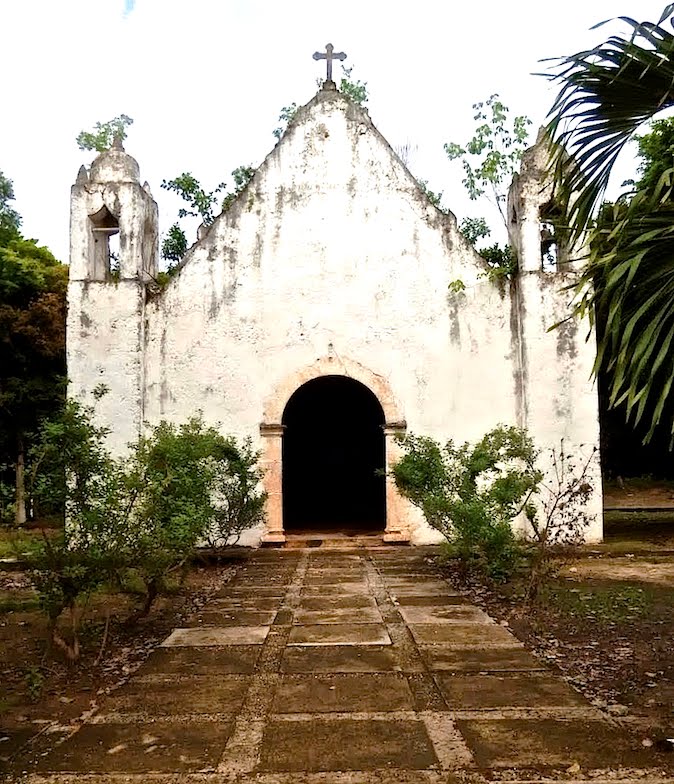
Although founded by the Dominicans as a visita of Tlacolula as early as 1526, the sober church dates largely from the 18th century. Two surviving posa chapels that sit on the west side of the large atrium may be earlier.
Posa © Box Wagner collection
 
The Church Front
Elegantly carved from pocked gray stone, pairs of fluted Ionic columns with carved bases form a triumphal arch around the church doorway, enclosing pointed shell niches. 
 
Above, ornate candelabra columns and finials flank an octagonal choir window as well as the sculpture niche in the scalloped gable.

Embedded pottery and azulejo tiles add color to the towers and cupolas, whose formerly painted estípite pilasters are capped by simian looking atlantes.
The Church Interior 
Currently painted in jarring tones of mottled blue and mauve, the nave is heavily outlined by chocolate-colored vaults, pilasters and cornices.
   A majestic gilded retablo fills the apse, its composition and refined detailing exemplifying the classic Oaxacan style. Foliated spiral columns frame large rectangular paintings of scenes from the life of St. Dominic, whose statue occupies the center niche. Oval medallions encircle the altarpiece.
Several other colonial altarpieces stand along the nave. As with the retablo mayor, twisting solomonic columns and jutting cornices encase the towering retablo of the Passion of Christ, set against the north wall.  
   Dated 1733, it is composed entirely of fine Mannerist inspired paintings in a compelling tenebrista style. These include the Baptism of Christ, a Purgatory scene and the Apotheosis of St. Peter with an angel bearing the Host. 
 
The principal panel of the Crucifixion with John the Baptist and St. Francis is especially dramatic. 
Fashioned in the same style and dated 1733, the smaller retablo of the Trinity against the north wall is a real gem. Inscribed portraits of archangels accompany a painting in popular style of the Coronation of the Virgin in the center panel. 
   An exceptional sculpture of the Holy Trinity, or Throne of Mercy, occupies the projecting vitrine. A classic among several such works found mainly in Oaxaca.
   
The Holy Trinity Crowning the Virgin;                       The Throne of Mercy 
One aspect of the church that strikes the visitor is the variety of its santos, placed in the retablos or beside altars along the nave, including a richly costumed figure of Christ entering Jerusalem, the Virgin of Sorrows in flowing floral robes, and another processional statue of the Virgin—very similar to the one seen at Santa Ana del Valle—with gessoed, painted garments stretched over a bell shaped wooden frame.

   As we follow on with this series, we will venture further up into the Sierra de Juárez to explore several other Zapotec mountain villages, their colonial churches and their works of art.
Visit our other Oaxaca pages:
IxtaltepecYucucuiTlalixtacTeotongoTlaxiacoTlacolulaSan Nicolás AyotlaTeposcolulaSeven PrincesVirgin Mary & St DominicManuel Fernandez FialloRose of Lima in OaxacaMiguel de MendozaOaxaca CathedralBaptismal FontsCasas de CortésYanhuitlan;
TejupanSan Agustín de Oaxaca; San Felipe Néri; Santo Domingo Tomaltepec;

Oaxaca murals: Santo Domingo muralsCuilapan muralsTeitipac muralsEtla muralsJalapa del Marqués;
text © 2018 Richard D. Perry
color images by the author and courtesy of Felipe Falcón

Sunday, August 5, 2018

Oaxaca: Santa Ana del Valle

We resume our coverage of Oaxacan missions and churches, starting from the Tlacolula valley south of the city of Oaxaca.
   Just north of the town of Tlacolula, a road winds east up a narrow valley towards the Sierra de Juárez. Three Zapotec hillside villages are located just off the road along this route, of which Santa Ana del Valle is the first. 
The church is the most modest of the three, cosily set in its leafy, walled atrium. An old, pitted atrium cross, carved with the nails of Christ’s Passion enclosed in a crown of thorns, stands in front.
   The folk baroque facade is typically Oaxacan, with elongated shell niches flanked by Ionic columns. Stucco ornament—urns, starbursts, rosettes, angel heads and much curving foliage—is accented in red, blue and gold. 
Inside, the church is crowded with diverse altarpieces and colonial art works as well as with carved floral decoration. 
The Main Altarpiece
In the narrow domed apse, its pendentives painted with the Four Evangelists, stands the hybrid altarpiece of St. Anne—part baroque and part neoclassical—hung with mirrors. 
   The retablo houses a folksy statue of St. Anne in the central vitrine, and above, two painted versions of the Annunciation. 
Another richly robed statue of St. Anne—the patron saint of the church and village—rests in an ornamental, "medallion" style altar flanking the apse.
The little rectangular side altarpiece of La Soledad is fashioned in traditional Oaxacan baroque style with richly gilded spiral columns and filigree. It is surmounted by a brooding portrait of John the Baptist. The pale features of the attenuated statue of the Virgin of Sorrows in the center niche suggest a Guatemalan origin. 
    
  
El Señor de la Misericordia, an emaciated cristohangs in another medallion style gilded altar.
Among the church santos, the elongated, freestanding figure of the Virgin of the Rosary, known locally as La Candelaria, is especially affecting with her tilted crown and fading costume paint. 
Finally, we should also draw attention to the folkloric, hand painted 18th century pulpit. A variety of historical documents and colonial artifacts are on display in the little museum beside the church.
text © 2018 Richard D. Perry

Wednesday, August 1, 2018

Yucatán: Pascual Estrella in Hunucmá

As an addendum to our recent series on the frontier churches of Yucatán, many of which feature the carvings of the Mayan sculptor Pascual Estella, we draw attention to his documented work at Hunucmá, in the northwestern corner of the peninsula.
The broad aisled church at San Francisco Hunucmá is raised up on an enormous platform that stands a meter or more above the surrounding plaza. The size of this platform indicates that this was once a major Maya ceremonial center, although no ancient structures now remain.
   Much of the present church dates from the later 18th century. The nave is long and wide, supported by exceptionally deep buttresses on both sides and covered by Yucatan style log vaults. The broad neo-classic facade, with its identical triple entries and clean, whitewashed front is a dominant local landmark. It extends beyond the nave to the full width of the side buttresses, rising up to a spectacular triangular espadaña, pierced by nine bell niches along the gable.
Every February, during the festival of Candelaria, the famous image of the Virgin of Tetiz travels in procession to Hunucmá from her home, enthroned on a weighty anda and borne on the shoulders of designated cargadores—members of local fraternities and gremios carrying their estandartes or banners
   There, amid great celebration with fireworks, music, the raising of banners and the throwing of confetti, she presides in state for over the town fiesta on a special altar for two weeks.
  
Items of special interest to us here are the ornate 18th century baptismal font and holy water basin inside the church, both boldly carved with cherubs and outsize foliage—the work of the Mayan sculptor Pascual Estrella and the only examples of his craft outside the frontier area of eastern Yucatán.
text © 2018 Richard D. Perry.   color images by the author and others
Other works by Pascual Estrella: Chemax; ChikindzonotIchmul; SacalacaSabán; Peto/Petulillo

Monday, July 30, 2018

Churches of the Yucatan frontier: Peto, Petulillo and Pascual Estrella

Petulillo, the church front
After long years of neglect, the imposing frontier church of Petulillo, on the Yucatán/Quintana Róo border, is finally undergoing cleanup and restoration. Although damaged and abandoned during the calamitous 19th century Caste War, this former visita of the grand neighboring church of Asunción Peto, retains its massive limestone walls and interior barrel vaulting.


Although the church was long ago stripped of its more perishable furnishings, two carved wooden beams from the choir loft have survived in place, all the more remarkable for their fine foliated decoration—a great rarity in Yucatán.*


The imposing sanctuary arch also remains, framing the remnants of a neoclassic stone retablo in the apse.
Petulillo boasts a lofty facade, with pierced and ornamented openings and capped by a triple espadaña. Undulating parapets top the nave walls, also pierced with stars.
Although undocumented, some elements of fine stone carving in the church may represent more work by the talented Mayan sculptor Pascual Estrella, whose oeuvre we have described in earlier posts in this series.
The items in question are first, the elegant corbeled balcony below the choir window, a signature element in frontier church architecture, other examples of which are either attributed to or known to be the works of Maestro Estrella—at Chemax, Sabán and the especially ornate example at Petulillo's mother church of Peto.
Asunción Peto, the church front
Peto, the carved choir balcony corbel
A second and even more interesting item at Petulillo is the large baptismal font inside the church, which has miraculously survived the centuries, although now in two pieces.
The font is closely related in style and sculptural quality to Estrella’s other fonts at Chikindzonot, Hunucmá and Tihosuco. Around the broad basin, angels' heads float above a boldly carved thicket of luxuriant foliage and blossoms. And another carved cherub raises his arms in support on the detached base of the font.


* The exceptional carving of these unique relics suggests a skilled hand—could it be of Pascual Estrella?  If so, these may be the only known extant examples of his work as a wood carver.
text © 2018 Richard D. Perry
images by JB Johnson, Miguel Bretos, Edwin Baas Garcia and online sources
Please visit our other pages on the frontier churches of Yucatán: 
Chemax; ChikindzonotIchmul; SacalacaSabán; Peto/Petulillo; Huaymax/X-querol;

Wednesday, July 25, 2018

Churches of the Yucatan Frontier: Huaymax and X-Querol

Having described the larger frontier churches of Sabán and Sacalaca, we should not leave the Yucatán/Quintana Róo border zone without a look at two of the typical smaller visitas in the immediate area, both of them in ruins since the mid-1800s and abandoned until recent times.
Huaymax in 1984

Concepción Huaymax
This little mission was an early victim of the 19th century Caste War. Until fairly recently, its crumbling belfries, fire-blackened choir beams and weed-filled sanctuary proclaimed its long neglect and disuse. These photographs, taken in the early 1980s, reflect its abandonment and neglect.
Huaymax, the burned choir loft. 1984

Huaymax started life as a dependency of the Franciscan mission at nearby Ichmul. Its primitive Indian chapel, the arch of which can still be seen, was expanded into a church in the 1700s, whose nave was covered by a steeply pitched, thatched roof, and faced with a stuccoed limestone facade with elegant "moorish" side belfries featuring pointed arches.

 
Although still missing its roof, the church has now been stabilized, cleaned up and reclaimed by local evangelists, who worship beneath a ramada—now metal instead of thatch—in front of the old open chapel/sanctuary, much like the Maya Christian converts of the 400 years ago.
 
.........................
San Juan X-Querol
Like Huaymax, X-Querol was burned out during the Caste War. Although the original thatched roof was destroyed, the new roof, part wood and part sheet metal, follows its original steep pitch, recreating the early internal ambience of the nave.
Here, diminutive towers replace the customary belfries on either side of the otherwise typical, plain triangular front. X-Querol also retains much of its original walled atrium—a rarity in Yucatan—possibly part of an old Maya sacbe.
January 2024. Further restoration of this historic visita chapel is under way under the auspices of INAH.

text © 2018 Richard D. Perry
color images by the author and courtesy of Benjamin Arredondo
Please visit our other pages on the frontier churches of Yucatán: Chemax; ChikindzonotIchmul; SacalacaSabán; Peto/Petulillo;