Translate

Sunday, April 16, 2023

Guanajuato. La Hacienda de Burras


LA HACIENDA DE BURRAS: a fragment of Mexican history 

Mexico abounds with significant historic sites - some celebrated and elaborately preserved, others neglected and virtually forgotten. In Guanajuato, the "Cradle of Independence", both kinds are to be found. While the former attract many visitors, few encounter the latter. We visited one of these out-of-the-way, neglected sites recently, still a place of authentic character and nostalgic melancholy.

Located some 25 kms SW of the city of Guanajuato, just off the main Highway 45, the former Hacienda of San José de Llanos, originally known as La Hacienda de Burras, was one of the first great rural estates acquired by the silver magnate 
José de Sardaneta in the 1700s. Initially devoted to cattle raising and agriculture, primarily to support the needs of his family and the mining community of Mineral de Rayas, this extensive hacienda later became a strategic storage and staging area.

As part of the vertical integration of mining operations carried out by Don José's son, the first Marqués de Rayas, this expanded hacienda de beneficio was the site of a company store and most importantly, an arrastre or innovative mule-driven stamping mill and refining facility to process silver ore, which may have given the hacienda its name, thus keeping this profitable aspect of mining under family control and substantially contributing to revenues. 


The Hacienda Chapel 
Originally dedicated to San Antonio de Padua, the modest 17th century chapel was rebuilt in the late 1700s and re-dedicated to San José, the namesake of the hacienda owner. A statue of the saint still rests in the niche above the doorway.

The chapel played a historic part in the saga of Mexican Independence: In September 1810, following the Grito de Dolores at nearby Dolores Hidalgo, Father Miguel Hidalgo led his ragtag army towards the key city of Guanajuato. Before the final assault, his troops were quartered at the hacienda, from where he sent an ultimatum (see below) to his former friend and liberal sympathizer, the Spanish intendenteJuan Antonio Riaño, who had withdrawn to the city stronghold of Alhóndiga de Granaditas* with 500 troops and many Spanish residents of the city. Before leaving the hacienda, Father Hidalgo celebrated an open air mass in the chapel patio. After a costly and bloody battle, the 20,000 strong insurgent force, coincidentally aided by a Rayas miner now famous as El Pípila, stormed the redoubt and killed all the defenders including Riaño.

Following the capture and execution of Hidalgo and his general Ignacio Allende a few months later at the hands of Royalist troops, the severed heads of the insurgent leaders were hung in baskets from the Alhóndiga walls. After Independence in 1821, the skulls were brought back to the hacienda chapel where the second Marqués de Rayas, a patriot and signer of the Mexican Declaration of Independence, ordered a requiem mass said in their memory.

Today, what is left of the main hacienda building is being used as a school, conserving some of the handsome original arcading and now happily, serving a worthy social purpose. Despite its historic role in Mexican history, the abandoned chapel has fared less well. The roof and tower have gone and only the much altered lateral facade and part of the atrial wall remain - in a poor state of preservation despite heavy-handed stabilization measures carried out some years ago


facade as restored


carved stone cross located in facade niche


 Especially poignant is the battered, armless statue of Father Hidalgo that still stands, its paint peeling, on an unmarked pedestal in front of the chapel - all that is left to remind the visitor of the role played by this former colonial hacienda in the turbulent pageant of Mexican history. 


Headquarters: The Hacienda de Burras, 
28th of September, 1810.

The numerous army that I command chose me in the fields of Celaya to be Commander in Chief and Protector of the Nation. That same city, in the presence of fifty thousand men, ratified this election, as have all the places through which I have passed.
I thus wish to inform your Excellency that I am legitimately authorized by my Nation to pursue such ends that I deem necessary for its benefit. These are equally useful and favorable both to Americans and Europeans [Spaniards] that have seen fit to reside in this kingdom, and simply proclaim the independence and the freedom of the Nation.


As a consequence, I do not view the European as an enemy, but only as an obstacle to the success of our enterprise. I charge your Excellency to present these ideas to those Europeans that are gathered in the Alhóndiga so that they may either declare themselves enemies or, if they choose, remain as our prisoners and receive humane and benign treatment - as do all those in our company - until freedom and independence are achieved, in which case they will become citizens, with the right to the restitution of such goods and possessions that, for the exigencies of the Nation, we have thus far appropriated. 
If, on the contrary, they will not accede to this request, I will apply all the force necessary to destroy them, without hope of sanctuary.


May God keep your Excellency many years, as so wishes your obedient servant,

Miguel Hidalgo y Costilla.
Captain General of America


text & pictures © 2003/2023 Richard D. Perry


Thursday, March 23, 2023

Puebla. La Trinidad Tepango

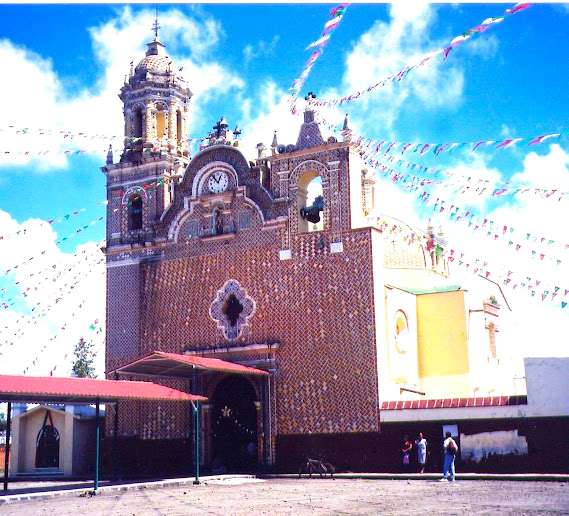
We have dedicated several pages on this blog to el barroco poblano, the distinctive, colorful, and arguably most influential regional expression of the popular baroque style in Mexico, best known for its glittering tiled facades and painted stucco decoration.

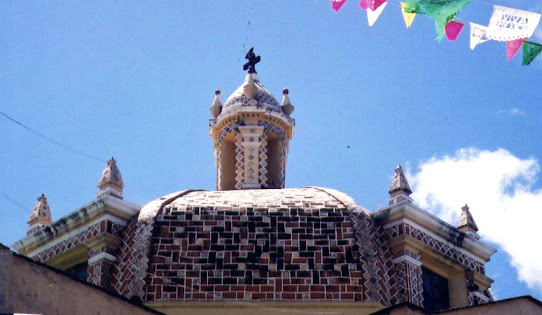
Located just south of Atlixco, a colonial hillside community west of the city of Puebla, the picturesque church of La Trinidad Tepango presents a particularly spectacular example of el barroco poblano. Its mosaic like tiled front carries the Pueblan style to the Nth degree. Every surface: facade, belfries, dome, gables and openings, is faced with polychrome tiles of every hue, some patterned in bright colors (azulejos) as well as plain tiles in more subdued earth tones (ladrillos) set in herringbone or zigzag patterns. In addition, many of the tiles are antique, dating from colonial times.


   Like the facade, the tower, dome and cupola are encrusted with stucco pilasters and painted pinnacles, adding even greater texture to the mix.

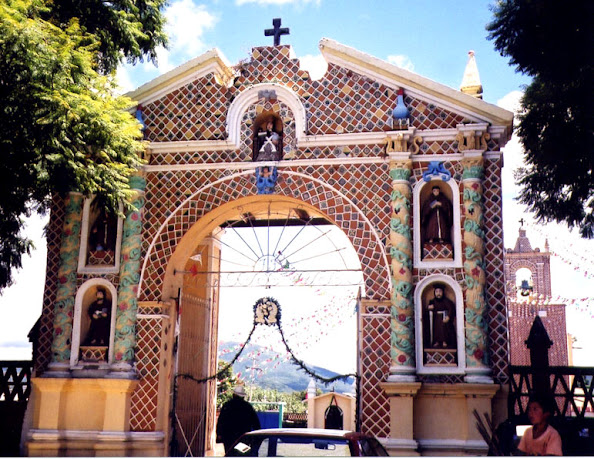
But as with San Juan in Atlixco, the church gateway is probably its most attractive feature, designed and ornamented in classic folk baroque style. Constructed in the form of a classical triumphal arch with baroque touches, the imposing entry is flanked by paired columns embossed with red and green vines that stand out against the tiled front. Unlike the facade, there are sculpture niches between the columns containing statues of brown robed saints in a popular vein, notably St Paul, while the diminutive figure of El Padre Eterno looks out from a gable niche above the main archway.

 
An inspiring display of vernacular architecture and ornament in a rural town.

text & photography © 2023 Richard D. Perry

Monday, March 6, 2023

Mexican Stone Crosses: Tlatilco


This 17th century chapel in the unprepossessing Mexico City neighborhood of Naucalpan, is chiefly notable for its surviving carved stone atrium cross from that period.

Set on a tiered pedestal in front of the church, the cross follows other area crosses in design, its rugged surfaces bearing on the front a stylized crown of thorns, and simplified fleur-de-lis finials on the arms and at the head of the cross on both sides.

fleur-de-lis finial
reverse side of cross

text © 2023 Richard D. Perry
color images © Niccolo Brooker

Wednesday, February 22, 2023

Aguascalientes: La Merced

The Temple of Nuestra Señora del Rosario , also known as the Temple of Mercy, is a church located in the historic center of the City of Aguascalientes.
   Around the year 1650, the Mercedarian priest, Fray Nicolás de Arteaga, arrived in Aguascalientes at the request of Don Pedro Rincón de Ortega. the spiritual director of the order. Upon his arrival, he proposed the creation of a college to teach writing, reading, grammar, and Christian doctrine to children. 
   In 1658, land was donated to the religious of Nuestra Señora de la Merced. A school and hostel were built there, as well as an early chapel. In 1665 permission was obtained to start the new church. This was built, starting in 1702 and finishing in 1773 according to a plaque inside the temple. The long delayed dedication of the church was on December 28, 1773.
   The Mercedarians had the church, the convent and the school under their custody, but this changed in 1859, when the Reform Laws were issued. The temple was then administered by the secular clergy; but later was assigned to the Dominican order, who changed the dedication of the temple to Nuestra Señora del Rosario.

Architectural Features
The entry gateway has a trefoil mixtilinear arch, set between elongated pilasters capped with urns. The diminutive figure of the Archangel Michael is carved into the keystone of the doorway.


The baroque stone façade stands out, its three tiers framed by estipite columns and pilasters.The facade niches retain stone statues of noted Mercedarians including San Pedro Nolasco, Santa María de Cervellón, San Ramón Nonato and San Raimundo. 


The second tier encloses a choir window again with a mixtilinear arch. Above the window is a tableau style relief, of the Holy Family or cinco señores with Jesus in the center; to the left, María and Santa Ana; and to the right, San José and San Joaquín. 
The top tier or gable features the Holy Trinity carved in bold relief; the Holy Spirit has a striking abstract quality.
The single two tier tower is framed with pilasters and columns with capitals, and neo-Gothic pointed arches on the upper tier.
Although the interior is much changed— the main retablo is neoclassical in style—one of the original altarpieces still survives in one transept. Designed in late baroque style, it features two tiers of gilded estipites with prominent winged circles—a trademark of the Ureña workshop located in Aguascalientes.

 text © 2023 Richard D. Perry
images © N. Brooker & ELTB

Search our other posts on colonial monuments in Aguascalientes.

Wednesday, January 25, 2023

Aguascalientes. The Jesus Maria retablo

Our next couple of posts will focus on churches of note in Aguascalientes, the city and its hinterland, not already covered in our blog: 

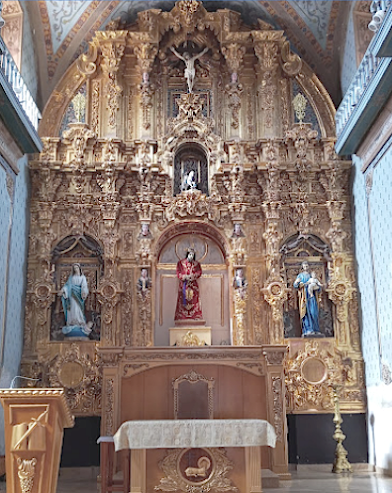
In 1735, the foundation were laid for the Church of the Nazarene in the town of Jesus Maria not far from the city of Aguascalientes. Although some of the labor and material costs were raised by alms, much of the funding was provided by the priest Colon de Larreategui, a relative of Colon de Larreategui the wealthy merchant who underwrote several projects in the region.
The church was completed by 1750, and a grand retablo mayor was installed, designed and constructed by Juan Garcia de Castañeda in the celebrated Ureña Aguascalientes workshop.

Although there have been some later changes, most obviously in the center pavilion and possibly the upper pediment, the retablo bears key features associated with the felipense style.       Narrow estípites, emblazoned with the signature “winged circle” motif and headed by opulent, elongate Composite capitals, frame the curtained sculpture niches on either side. 


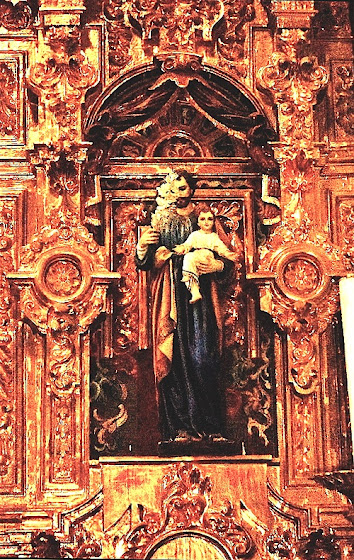
It is possible that this sumptuous work may, in fact, be one of the altarpieces originally created by the Ureñas and García de Castañeda for the cathedral in the city of Aguascalientes—one that was dedicated to San José and later reportedly destroyed. The statue of St. Joseph is especially fine, giving weight to the story.!

text © 2023 Richard D. Perry. Images courtesy of Nick Brooker and online sources.
look for our forthcoming story of Felipe de Ureña and ghis family

 Known as El maestro transhumante, the "peripatetic master", Felipe de Ureña was the most influential of the Mexican born architect /designers to introduce and expand the Churrigueresque or barroco estípite style into New Spain. During the second half of the 18th century, together with family members, he was primarily responsible for the spread and subsequent evolution of this ornate late baroque style into cities across Mexico, especially along the silver routes north of Mexico City. Primarily an innovative designer and fabricator of altarpieces, he later adapted the barroco estípite style as it was called, for church facades. His elegant and distinctive designs are recognized as the "felipense" style.
View these links to some other Ureña altarpieces: Rayas ChapelAguascalientesCataLa Valenciana

Friday, January 13, 2023

Chiapas. Cuxtitali

This charming little ermita church is located at the heart of a barrio on the northeast edge of the city of San Cristóbal de Las Casas. Built in the 1650s, it was originally subject to the nearby priory of Santo Domingo.
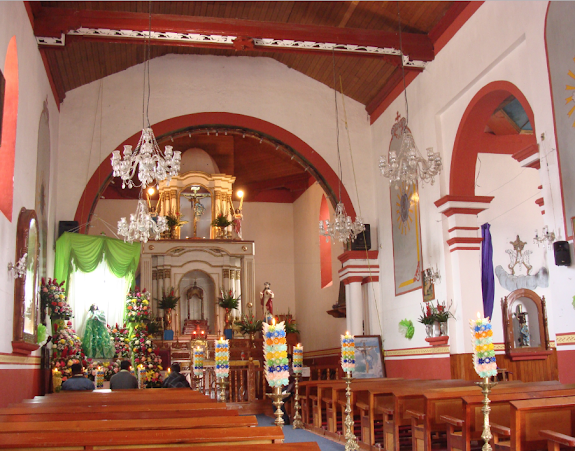
Cuxtitali is a classic pueblo-de-indios church, its simple nave covered by a pitched artesonado roof in the Chiapanec style. Brick buttresses reinforce the original adobe walls and an external stairway on the north side gives access to the raised, wooden choir.
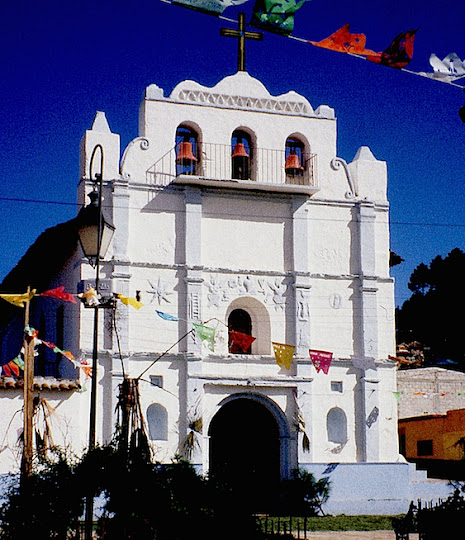
    The facade is a rustic delight with ever changing colors. Recently, its naive architectural and decorative elements were picked out in baby blue against the brilliant whitewashed front. The rounded arches of the various openings—the doorway, the choir window, the side niches and the upper bell arcade—create a pleasing counterpoint to the grid of flat pilasters and string courses. Whimsical corner volutes and a zig-zag frieze energize the undulating gable of the espadaña, which is also accented by a trio of red bells. 
But the most intriguing feature of the facade is the cluster of naive stucco reliefs depicting the instruments of Christ's Passion. The sacred heart, embossed above the choir window, stands amid the scourge, the crown of thorns, the crowing cock and the hammer and nails, accompa-nied by a pair of hovering angels. A ladder and an overflowing chalice appear on the adjacent pilasters flanked by a folksy sun and moon.
Seasonal decoration of the church reaches its height during the barrio fiesta of El Dulce Nombre de Jesús, held early in January. At that time, the venerable statue of San Sebastián, which stands on an altar in the church, is dressed in an elaborately looped loincloth, Guatemalan style, in readiness for his saint's day at the end of the month.


text and images © 2023 Richard D. Perry
all rights reserved

Friday, January 6, 2023

Yucatan. Feliz Dia de Los Reyes

At the beginning of last year we decided after ten years to taper the posts on this blog. We have done this but at year's end still have a number of items to post which we will do over the next few months on an occasional basis.

Thanks again to all our readers who have supported us over the past decade.

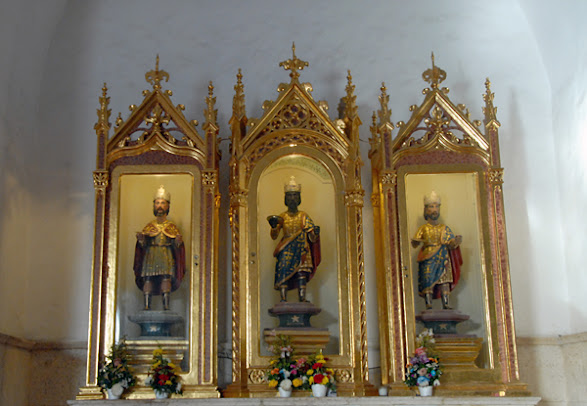
As is our custom we mark January 6th, El Dia de Los Reyes with images of the Three Kings from different parts of Mexico.

This year we show a variety of folkloric figures from Yucatán.

Tizimín
Telchac
Temax
Chikindzonot
Ichmul
Izamal

Feliz 2023 a todos

images  ©1988/1990 Richard D. Perry