Translate

Thursday, October 13, 2022

Santa Cruz de Tlaxcala: a side altar

A while back we ran a series of posts on altarpieces in Tlaxcala, as well as a special feature on unique paintings in the celebrated church of Santa Cruz.
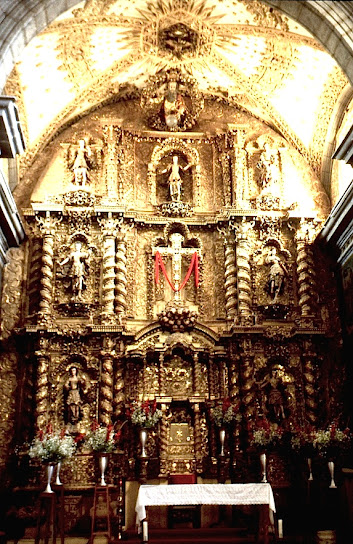
retablo of Santa Elena
In this post we look at another retablo in the church, one dedicated to a seldom referenced saint Santa Elena, or St. Helen, the mother of  the emperor Constantine the Great.
main altarpiece
Fashioned in the Solomonic baroque style, like the highly ornate main altarpiece of the church, resplendent with gilded spiral columns, the retablo showcases a statue of the saint in the center niche holding a cross, surrounded by paintings relating episodes in her legendary discovery of the true cross.

text © 2022 Richard D.Perry
color pictures by the author and Niccolo Brooker.
See our posts on other Tlaxcalan retablos: Tepeyanco; Zacatelco; Santa Cruz de Tlaxcala; Apetatitlan; San Jose

Tuesday, October 4, 2022

Zacatecas. The Cathedral 2

This the second of two posts on the magnificent cathedral of Zacatecas.
Besides the west front, the cathedral possesses two contrasting facades framing the lateral entries. Both are later than the main body of the cathedral dating from the 1770s.
The South facade more closely follows the west front: the doorway, framed here by geometrical relief, is flanked by tritostyle columns encrusted with vine reliefs. Above, the figure of N.Sra. de los Zacatecos occupies a grand niche flanked by spiral columns and medallions of saints enveloped by passages of dense floral vegetation. Two archangels and an ornamental cross cap the facade.
Although of similar date, the North facade is fashioned in a more eclectic manner: winged caryatids cap the Corinthian columns to either side of the doorway above which angels hover with Instruments of the Passion in the spandrels.
The upper section is dominated by a curtained Calvary scene in which the crucified Christ is flanked by figures of the Virgin and St. John set on pedestals supported by putti. Freestanding reliefs of angels outflank the framing estípite pilasters.
   As in the west facade, God the Father emerges from banks of scrolling relief foliage in the crowning gable.

text © 2022 Richard D. Perry
photography courtesy of Niccolo Brooker

Friday, September 23, 2022

Zacatecas. The Cathedral of the Assumption 1

In earlier posts we have looked at various colonial treasures in the state and city of Zacatecas*.
In this and a subsequent post we tackle the preeminent monument in the city: the cathedral of the Assumption.  See our earlier post on the cathedral crucifix.
This unique baroque building boasts three facades of unparalleled ornamental richness, informed by a popular feeling. Begun in 1729, several noted designers and architects contributed to its final appearance. 
In this first post we look at the west front of the cathedral, a classic example of Mexican horror vacui with no surface left undecorated. 
The fantastical, shield like facade, sculpted in rose colored stone, rises in three tiers, each framed by spiral columns wreathed in vines, shells and angels; pearls fruit and feathers are embedded in the tapestry of relief vegetation that fills the intermediate spaces. 

 Between the columns ornamental niches with sculpted pedestals house figures of Christ and the Apostles—13 in all. 
Above the mixtlinear porch, a rose window also ringed by luxuriant relief opens in the middle tier,

A relief of God the Father stands alone in the surmounting gable niche, accompanied by musical angels almost lost in the mass of surrounding floral relief.

text © 2022 Richard D. Perry
photography by the author and Niccolo Brooker

Friday, September 16, 2022

Michoacán. San Nicolás Chucándiro

The church front before restoration

Originally founded by the Franciscans and later ceded to the Augustinians as a dependency of Cuitzeo, this early mission in the northern Michoacan lakeland was rebuilt in the 1640s as a full convento. 

the church front as restored
It has recently undergone major work; a round turret has been add to the bell tower and a second belfry built atop the south wall. 

The facade with its imposing cut stone entry has been cleaned and repointed, drawing attention to the unusual reliefs around the doorway, which may represent plants or possibly symbolize the spouting waters of the hot springs that gave Chucándiro its place name, also perhaps related to the reliefs on the sanctuary vault.

Other renovations include the opening up of the old porteria beside the church and refurbishment of the attractive two story cloister notable for its prominent shell reliefs—a classic decorative motif in Michoacán.

Another curiosity is the carved stone atrium cross topped with a sundial.

text © 2022 Richard D. Perry

images courtesy of Niccolo Brooker, Diana Roberts and online sources.

Monday, September 5, 2022

Mexico. San Miguel Atlautla

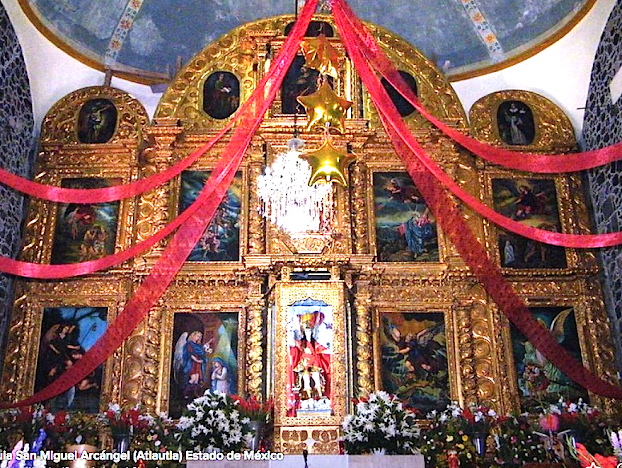
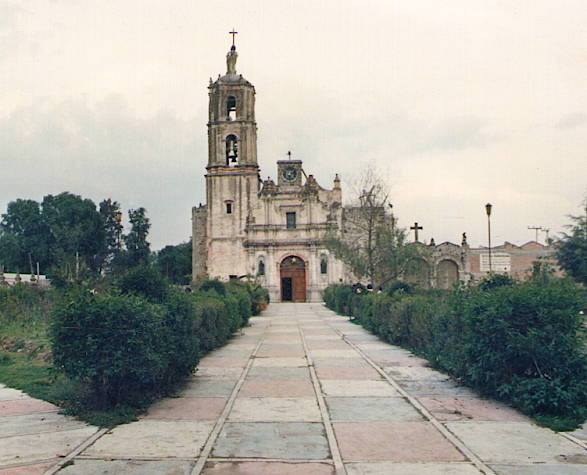
Set in the shadow of the volcano Popocatepetl, the church of San Miguel Atlautla appears hewn from local basalt blocks inside and out.
Beside the dark, cliff like exterior stands a stone cross, also sculpted from local basalt with numerous symbols of the Passion in high relief.
The principal colonial artifact inside the church is the expansive early 18th century altarpiece, replete with gilded spiral columns and home to a recently restored statue of the titular saint as well as colonial paintings of archangels. Several other paintings illustrate scenes from the life of Christ.
The porteria beside the church leads to an overgrown patio.

text © 2022 Richard D. Perry
color images from online sources

Saturday, August 27, 2022

Mexico. San Pablo de Las Salinas

 This dismal outlying barrio, just north east of Tultitlan, in northern Mexico City nevertheless boasts a pretty church dedicated to Saints Peter and Paul. It is also home to a number of notable carved stone crosses.

The Church

The single nave church with added south aisle dates from the mid 1600s. It is fitted with a modest retablo style facade that houses statues of the patrons Sts Peter and Paul.

The Main Altarpiece

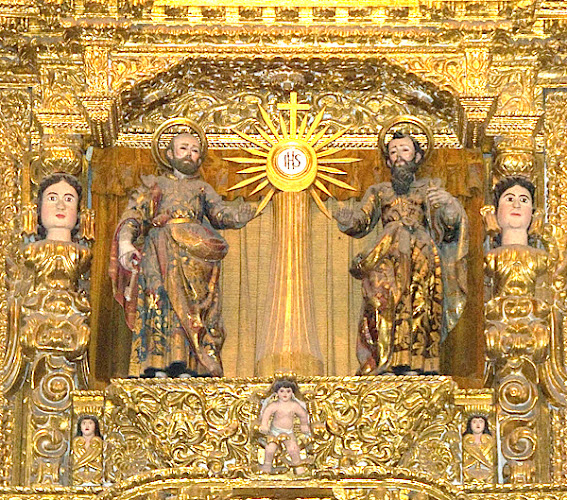
Fashioned in ornate baroque style with gilded spiral columns and estípites headed by angels' heads, the retablo showcases paintings of Franciscan saints and martyrs together with, again, statues of Peter and Paul, here flanking a monstrance in the upper section.


The Atrium Cross

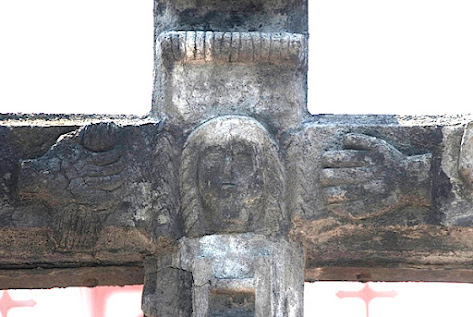
Of uncertain date, this large cross is crowded on all four sides with symbols of the Passion carved in soft relief. The dejected, puffy Face of Christ at the axis trails long locks of hair but wears no visible Crown.

Following the pattern of many others in the area, profile heads and hands on the arms point inwards to the Face. Wounds with pierced holes and droplets of blood are squeezed in beside the finials on either side; a third Wound is inserted below the Lad- der on the main shaft.

Other objects include the Rooster atop a conical Column emblazoned with Lance, Reed and a superimposed Host. A ridge of stacked Coins transects the neck below the INRI placard, and a goggle eyed Skull and Bones jut from the pedestal at the foot of the cross.

On the reverse side, a Crown at the axis stands in a column of religious monograms. Unusual reliefs include that of the Virgin, reminiscent of the Dolorosa at Acolman, above a ghost like flying angel. Bold fleur-de-lis finials with lozenge like leaves cap the arms and head.

A former porteria fronts the convento. A sculpted cross, also carved with Passion symbols, stands atop its triple arcade.

porteria cross

A fine triple west gateway, also capped with carved crosses, commands access to the large atrium.

text © 2022 Richard D. Perry

images courtesy of Niccolo Brooker and ELTB 

Sunday, August 21, 2022

Mexico. Santiago Ayapango

Resting on the southern slopes of the volcano Popocatepetl, the former convento of Santiago Ayapango was founded by the eminent Franciscan Fr. Martín de Valencia in the mid 1500s as a visita of Tlalmanalco.
The present cruciform church rests atop the foundations of the 16th century mission here, and the front is fashioned in baroque style with construction dates from the mid 1600s to the early 1700s.
Half columns with wavy fluting frame the doorway whose arch is adorned with scrolled vegetal reliefs.
   Similar reliefs in grotesque style patterns accent the features of the upper facade—the paired columns beside the choir window, a round opening in the gable and the pilasters to either side of the sculpture niche above the doorway, which contains an archaic stone statue of the patron Santiago Matamoros which may date from the early years of the mission.
Similar reliefs also adorn the spiral Corinthian columns framing the openings of the bell tower, which is oddly emblazoned with a folkloric relief of St Barbara?:

Inside the church, the main altarpiece is executed in late baroque fashion with estípite pilasters, paintings and statuary that include St Francis, Our Lady of Sorrows and the image of St James as a pilgrim (Santiago Apostol).
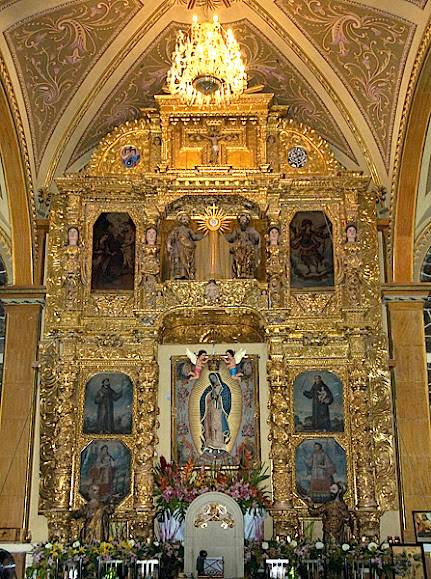
Other colonial art treasures of note inside the church include a small but gem like retablo of Guadalupe framed by gilded spiral columns; and a densely composed early18th century painting of the Redemption or Animas/Last Judgment signed by the artist Diego de Rojas.
A dashing equestrian figure of Santiago Matamoros rests in the nave, to be taken out in Procession on his feast day in July.
The former convento, with its well kept cloister, adjoins the south side of the church.

text © 2022 Richard D. Perry
images courtesy of Niccolo Brooker and ELTB