Translate

Showing posts sorted by date for query acatzingo. Sort by relevance Show all posts

Tuesday, September 17, 2024

Morelos: Ocuituco fountain

Adding to my previous posts on outstanding colonial fountains,* this is a post on the example in the monastery at Ocuituco. 

The church front as restored in 2020

The large hexagonal fountain is set on a similar pedestal in the center of the cloister. Carved stone lions crouch on each corner, several of them now headless.
Currently the fountain does not function.


text and color photography © 2024 Richard D. Perry


Monday, January 1, 2024

Puebla. Los Reyes de Juarez

As is our custom at t his time of the year we like to feature a church dedicated to the Three Kings, or Los Reyes Magos

In this post , the first of two, we look at the town of Los Reyes, a medium size market town in central Puebla state, across the autopista from Acatzingo, SE of the city of Puebla.

This is the first of two posts on the church, focusing here on the ornate facade of painted stucco relief.


Facade:  

The church of the Three Kings presents a triple tier facade in the lacy, wedding cake style of popular Pueblan baroque,; its classical retablo format is enhanced with abundant applied surface ornament of carved stucco in good condition, and usually painted orange or yellow.

Lower tier: classical fluted columns are set on complex, raised carved bases.  doorway. Applied surface decoration - whorls, foliage starbursts, etc - appear on and between columns, and in spandrels over the plain arched doorway. 

Oval medallions between the columns framing stucco reliefs of the  Four Evangelists in folkloric style each with his symbol.

 Matthew                           Mark
 Luke                               John
The second tier features rectangular pilasters with scrolled/foliated ornament densely carved in low relief.   Oval cartouches between pilasters show the two other Evangelists (Mark & Luke) 

The plain rectangular choir window is flanked by ornamental relief pendants

Decorative pinnacles extend above pilasters into the gable area. 

The large center relief medallion shows one of Magi kneeling before mother & child, flanked by two other kings (reyes) on horseback.  A stucco star above at apex, is supported by angels.

The gable is capped by a sinuous projecting mixtilinear pediment.  

Giant pilasters flank the entire facade, ornamented in the same fashion as the upper tier pilasters, as are the cornices between the tiers.A substantial, triple staged tower with prominent tiled dome on south side. 

  The ornamental atrium gateway follows the facade in style.

© 2024 Richard D. Perry

images by the author and © Niccolo Brooker by permission


Sunday, July 26, 2020

Puebla. The Acatzingo fountain

In an previous post we described the early baptismal font in the Franciscan monastery church of Acatzingo, in Puebla. In particular we noted the unique relief of the town place glyph carved on one side.
In this post we look at the related fountain located in the patio of the adjacent parish church, a sumptuous, later colonial tiled building in the Pueblan style.
Acatzingo, the parish church
Although not currently functioning and not clearly dated, the essential elements of the fountain remain in place; it has several features of interest, including corner reliefs, some replicating the ancient place glyph of the community in the monastery church.
Each relief - four in all - is held up by a helmeted angel, a figure also derived from the monastery church font. Elements include a heart pierced by an arrow, crossed eagle claws, one feathered, the other almost skeletal, a feathered headdress and below, two reeds emerging from water—a clear reference to the ancient place name (Where Reeds Grow)
Four lion's heads with embedded spouts sit atop the central column ringed by a now indecipherable inscription, while additional spouts issue from the helmets of the angel reliefs.
text © 2020 Richard D. Perry 
images by the author and courtesy of Niccolo Brooker

Thursday, April 9, 2020

Calixtlahuaca: The Baptismal Font

Before it was conquered in the mid-1470s by the Aztecs, Matlatzinco had been an independent community in the northern part of the Valley of Toluca, in western Mexico state. The Aztecs renamed the city Calixtlahuaca, “Place of the Plain of Houses,” and erected new buildings in the ancient city center with stone sculptures in Aztec Imperial style.
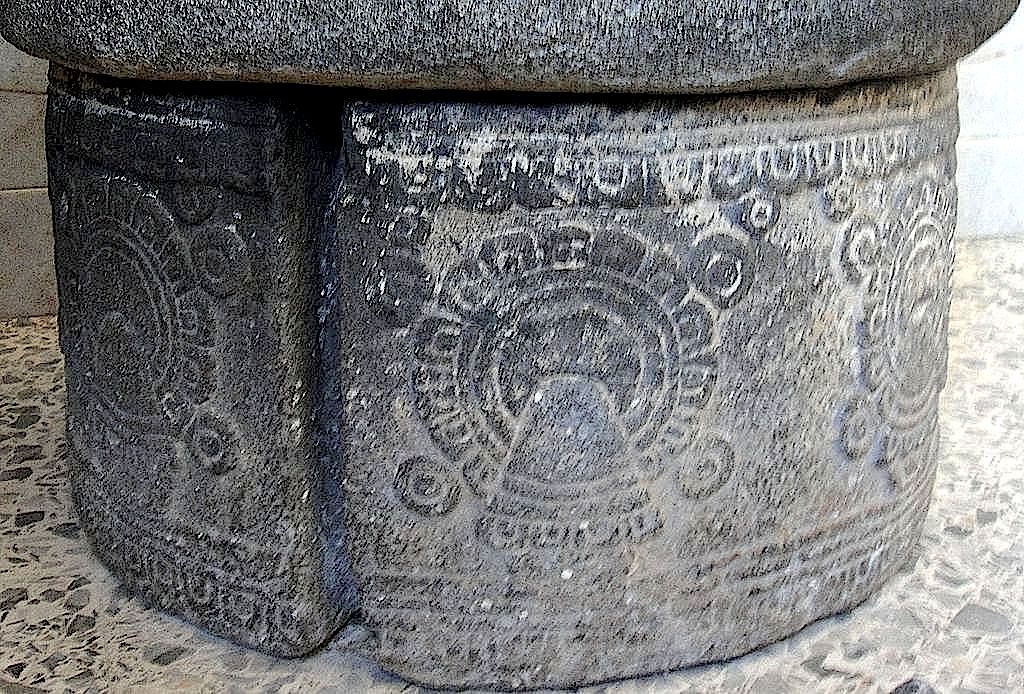
These monuments included at least two carved, cylindrical pedestals that may have been altars for heart sacrifice. One of these, found on the platform in front of the round temple of the Wind God (Ehecatl), is now located in the main church of San Francisco, serving as a base for the colonial baptismal font. 
   The surmounting font is ringed by the Franciscan knotted cord motif and carved with religious monograms.


 The prehispanic sacrificial stone underlying the font is carved in the Aztec imperial style and is thought to date from the late 15th century, after the Aztecs took political control of Calixtlahuaca.  
   The carved cylinder is ringed by a frieze whose repeated motif features a helmeted head against a crenelated circle flanked by representations of a jade bead—a symbol associated with death, sacrifice and renewal. A deep channel cut into one side, if original, may have been to drain blood from the surface above.
courtesy of Jim Cook
The second altar, now in the site museum at Calixtlahuaca, was also found at the base of the temple of Ehecatl by the pioneering archaeologist José Garcia Payón.
composite image of cemetery chapel courtesy of Michael Smith
Although the main church in San Francisco Calixtlahuaca only dates from the nineteenth century, the smaller cemetery chapel  (panteón) nearby is much older and is probably the original mission site, founded in part on a pre-conquest platform. 
date stone (image courtesy of Michael Smith)

The chapel has a carved stone relief embedded in its rear wall bearing the date "1563 año" and below it, the equivalent for that year in the Aztec calendar (6 Reed). Closed up for many years, the chapel has recently been restored.
text © 2020 Richard D. Perry.  
images courtesy of Michael Smith and Jim Cook
* Please see our earlier posts featuring early Mexican fonts of interest: Yucatán; Oaxaca; Michoacan; Zacatelco; Tlalmanalco; Cuernavaca; Tepoztlan; Zacualpan; Otumba; Chimalhuacan; Acatzingo; Tlaxcala; Zinacantepec; Tecali; Tecamachalco; 

Monday, April 6, 2020

Hidalgo. Epazoyucan: the baptismal fonts

In previous posts we have described the church and convento of Epazoyucan, in the state of Hidalgo. Here we look at early artifacts inside the church.
The church at San Andrés Epazoyucan houses at least two early stone baptismal fonts. The first, located in the baptistry itself is the more distinctive, its monolithic basin crisscrossed with basket like lattice work, giving it the appearance of an outsize pineapple. 
   This archaic look and its presence before a 16th century mural of the Baptism of Christ suggest a possible Franciscan origin antedating construction of the Augustinian church from the 1540s.
A second font stands before the altar steps in the nave.  Set atop a pedestal carved with relief decoration, the basin is scalloped in a shell like pattern, and spouts in the form of fish or animal mouths are let in below the rim suggesting its possible origin as a fountain.

* Please see our earlier posts featuring early Mexican fonts of interest: Yucatán; Oaxaca; Michoacan; Zacatelco; Tlalmanalco; Cuernavaca; Tepoztlan; Zacualpan; Otumba; Chimalhuacan; Acatzingo; Tlaxcala; Zinacantepec; Tecali; Tecamachalco; 
text © 2020 Richard D. Perry
images by the author

Friday, April 3, 2020

Hidalgo. Santa María Nativitas: The Baptismal Font

In our ongoing series documenting early baptismal fonts* we visit the former Franciscan visita of Santa Maria Nativitas, located in eastern Hidalgo. 
Much remodeled since its founding in the early 1600s, and set atop what may be a prehispanic mound or platform, the church contains few reminders of its Franciscan origins, with the notable exception of its striking, carved stone baptismal font.
The monolithic basin is ringed by the Franciscan knotted cord linked to ornamentally framed reliefs of the Stigmata. The principal relief is atypical in that the customary Five Wounds surround a cross with two shafts or spears.
 In addition, a pair of animal heads appears below the main relief.

* Please see our earlier posts featuring early Mexican fonts of interest: Yucatán; Oaxaca; Michoacan; Zacatelco; Tlalmanalco; Cuernavaca; Tepoztlan; Zacualpan; Otumba; Chimalhuacan; Acatzingo; Tlaxcala; Zinacantepec; Tecali; Tecamachalco; 

text © 2020 Richard D. Perry
images courtesy of © Niccolo Brooker

Wednesday, June 19, 2019

Barroco Poblano: SAN PEDRO TECOMATLAN

After the mid-1700s, the influential Pueblan baroque was in turn influenced by newer fashions, notably the Mexican Churrigueresque or barroco estípite style, which spread from Mexico City to the silver cities of the north, and south to the colonial cultural capital of Puebla. Strongly influenced by the stucco facade of La Compañía (date) in the city of Puebla, in the late 1700s this new style reached its popular apogee in a handful of other rural churches such as Acatzingo, Aljojuca and San Pablo de las Tunas in the central part of the state.
However, the distant plain of southern Puebla, known regionally as la mixteca poblana, seems an unlikely place to find this decorative example of the late Pueblan baroque. Although the parish church of San Pedro Tecomatlán dates back to 1500s, it was substantially rebuilt in the latter years of the 18th century, and fitted with an elaborate facade in the still fashionable Mexican Churrigueresque style.
 
San Pedro Tecomatlan facade before and after recent restoration
The Facade
Although the architect and source of funding for this ornate church front is so far unknown, the facade is remarkable for its profusion of statuary and relief ornament in a popular folk idiom. The decorative center facade is framed by its two pairs of elaborate estípites, decorated with herms and grotesque masks. Prominent niche-pilasters (interestípites) in carved stone and modeled stucco feature the statues of the Four Evangelists, housed in swagged niches complete with their associated symbols, and quill pens held aloft.
A naive, frontal figure of St. Peter (San Pedro) rests in a plain niche over the doorway. Above the "bulls-eye" choir window, a group of flying angels in 16th century style surround a curtained upper niche which contains another small statue. A pair of large, naked atlantes support the crowning gable. Every element is densely ornamented with delirious swirls of vegetation & scrollwork.
St Mark
Unfortunately, some of these figures have been mutilated in recent years, notably St. Matthew's faceless angel. and St. Mark's now headless lion.
St Matthew
Text © Richard D. Perry 2005/2019
Color images ©2004 Felipe Falcón, by special permission.

Please review our earlier posts on the folk baroque churches of Puebla: San Jeronimo Aljojuca; Santa Inez Xanenetla; Tlancualpican;  Santa Ana Jolalpan; Santa Maria Jolalpan;  San Simón Quecholac; San Pablo de Las Tunas; 

Friday, June 14, 2019

Barroco Poblano: San Pablo de Las Tunas


We continue our series on the popular baroque churches of Puebla with a visit to the former Franciscan visita of San Pablo de Las Tunas, aka Felipe Angeles, set among cactus fields in the east central part of the state near Acatzingo.
  
The Church
Aside from its rustic name, the village of San Pablo (St. Paul of the Cactus Fruits) is mainly remarkable for the picturesque colonial church, situated on its western outskirts. Founded in the 1500s, the church was entirely refaced during the 1700s in a style strikingly similar to the renovated parish church of nearby Acatzingo, possibly by the same designer or artisans.
   The ornate "folk baroque" facade is divided into three tiers of carved, molded and colorfully painted stucco. Bold spiral columns, some capped with busts of angels, divide the lower two tiers, whose four large niches, now vacant, are festooned with drapes and putti.
The complex top tier is an elaborately scrolled gable whose sinuous profile is made even more conspicuous with the addition of several ornamental urns or pinnacles. The central niche, framed by flamboyant rocaille decoration, retains its bulto of San Pablo, and is flanked by exuberant folk estípite pilasters, once again entwined with carved foliage, from which emerge numerous winged cherubs and saints' heads. 
   Filled with other decorative motifs, including rosettes, scrolls, shells and assorted objects - their details freshly picked out in bright reds, blues and earth colors - the church front is beautifully maintained and a feast for the eye. Its symmetry is offset by the mismatched towers and an added belfry, although this merely adds to its offbeat charm.
The Main Retablo
This extraordinarily ornate gilded altarpiece provides yet another surprise in this rural community. Designed in full blown Mexican Churrigueresque style, it is far more sophisticated in its intricate, layered forms and masterful execution than the folk baroque facade, and indicates the work of an accomplished urban taller, or workshop, probably in Puebla or even Mexico City. 
  
The figure of the patron St. Paul appears in the upper niche, while another image is that of a sorrowful Jesus, known as El Señor de la Paciencia.
 
The baptismal fonts are also items of interest in the church. One venerable example, rimmed with fleurs-de-lis and the Franciscan knotted cord, stands beneath the choir. And the basin of a second font is ringed with an unusual crown of thorns relief—a motif more common on stone crosses—and set on a base carved with an archangel.
 text © 2019 by Richard D. Perry
color images by the author and Niccolò Brooker
Please review our earlier posts on the folk baroque churches of Puebla: San Jeronimo Aljojuca; Santa Inez Xanenetla; Tlancualpican;  Santa Ana Jolalpan; Santa Maria Jolalpan;  San Simón Quecholac; San Pablo de Las Tunas; 

Friday, May 25, 2018

Zacualpan de Amilpas: The Baptismal Font

In a previous post in this series, we looked at the monolithic baptismal font at Tlalmanalco, whose rim was inscribed with the Latin legend:  
Qui crediderit et baptizatus fuerit, salvus erit; qui vero non crediderit, condemnabitur.
Whomever believes and is baptized will be saved; but he that believeth not shall be damned.
The first part of the same quotation, from the gospel of St. Mark, is carved on the rim of a more complex font at Zacualpan de Amilpas in nearby Morelos state.
© Niccolo Brooker
Below the inscribed rim, the delicately delineated, shell like form of the basin rests on an inner ring carved with cannonball reliefs.
But the most extraordinary feature of this font is the outer ring, with its freestanding supports of luxuriant carved foliage modeled in high relief.
© Niccolo Brooker
text © 2018 Richard D. Perry
See our earlier post on the early colonial murals of Zacualpan

Please see our earlier posts featuring early Mexican fonts of  interest: Oaxaca; Yucatan; Michoacaneast; Atlixco (Puebla); Acatzingo; Tlaxcala; Cholula; 
CiudadHidalgo; Tepepan; Molango; Tecamachalco; Quecholac; Tecali; Zinacantepec; Cuernavaca; Otumba; 

Thursday, May 17, 2018

Otumba: The Baptismal Fonts

In our first post on Otumba we looked at the sculpted doorways of the church and convento.  For our second post we survey other examples of early stonework there, notably the various fonts.
Carved stone basins in all shapes and sizes proliferate in the church. They have a family resemblance, ringed with the Franciscan knotted cord and emblazoned with large, eight-pointed rosettes.
The larger baptismal font, housed beneath a shell niche in the baptistry, sports huge ball pendants and a trumpet-shaped hood.  This font is accompanied by a smaller version as well as a third font with a barbed quatrefoil basin, foliated swags and an inset ceramic bowl.


The knotted cord rims another font in the nave, in front of a similarly banded dado, also with star-like relief rosettes. 
Finally a more elongated version rests in the convento, carved with four petaled rosettes and a cross relief.
text © 2018 Richard D. Perry. images by the author and ELTB

Please see our earlier posts featuring early Mexican fonts of interest: 

Thursday, May 3, 2018

Tlalmanalco: The Baptismal Font

In our series of posts on the early baptismal fonts, we go next to the venerable Franciscan monastery of San Luis Obispo Tlalmanalco to look at its historic font.
The open chapel baptistry
Originally placed in an arched baptistry to one side of the grand open chapel, formerly accessible through the church, this monolithic stone basin, now located inside the nave, may be the earliest documented baptismal font extant in Mexico.
Reportedly carved in 1533 by order of Fray Martín de Valencia, the leader of the first Franciscan Twelve and at that time Guardian of Tlalmanalco, its large, round basin is emblazoned with heraldic monograms of Jesus and Mary and the Franciscan emblem of the Five Wounds, as well as unusual foliated or feathered pedestals or urns.
   Of special interest is the unequivocal Latin quotation from the gospel of St. Mark (16:15) carved around the rim:

Qui crediderit et baptizatus fuerit, salvus erit; qui vero non crediderit, condemnabitur.
Whomever believes and is baptized will be saved; but he that believeth not shall be damned.

text and color image © 2018 Richard D. Perry
Please see our earlier posts featuring early Mexican fonts of  interest: Oaxaca; Yucatan; Michoacan-east; Atlixco (Puebla); Acatzingo; Tlaxcala; Cholula; Ciudad Hidalgo; Tepepan; Molango; Tecamachalco; Quecholac; Tecali; Zinacantepec; Cuernavaca; Otumba; 

Thursday, April 26, 2018

Chimalhuacan: The Baptismal Font

  
Chimalhuacan, the west doorway;            the atrium cross (Niccolo Brooker )
Aside from its spectacular mudéjar doorway and sculpted atrium cross, the other 16th century relic of note at the former Dominican church of San Vicente Chimalhuacan is its historic baptismal font.
Although celebrated mainly for its connection to the great Mexican poet Sor Juana Iñez de La Cruz, who was baptized here in 1651, it is also one of the earliest documented carved stone fonts in Mexico.
   Like most early colonial fonts, it is monolithic, carved from reddish brown basalt, and set on a round base. Below a plain rim two broad bands of intricately carved, highly stylized foliated ornament encircle the large basin.
   Between them is a Latin inscription in bold relief, marked 1542, naming the pope of the time, Paul lll (1534-1549) thus confirming its early date:
ANNO D(OMI)NI  M XLII.  PONTIFICANTE PAULO TERTIO. AD LAUDEM DEI
text © 2018 Richard D. Perry
images by the author, courtesy of Niccolo Brooker and online sources


Please see our earlier posts featuring early Mexican fonts of interest: